Table Of Contents
The Basics
As with any language, verbs are rather important; in fact, many of the cases you should have learned by now are useless without a verb. Therefore, it is rather important that you understand how verbs are conjugated.
There are several irregular verbs in the Russian language, but only the two most important ones will be discussed here: быть (to be) and иметь (to have).
Conjugation of Быть
The verb "to be" is one of the most important in any language, which is why the Russian simplified its use and made it nonexistent in the present tense. That's right, in the present tense, there is no conjugation of быть, it is simply implied. As an example, if you wanted to say "That is my pencil," you would simply say "Это мой карандаш" or, in literal terms, "That my pencil."
However, быть does have conjugations in the three other tenses (yes, there are only four tenses in Russian): the past, future, and conditional-subjunctive. Hopefully, you already understand what the past and future tenses are, but the conditional-subjunctive may be new to you. Basically, the conditional-subjunctive tense is a mix of what you "would" do (the conditional) and what you "should" do (the subjunctive). For example, the phrase "Я читал бы" can mean both "I would be reading" or "I should be reading." There is a lot more complicated grammatical concepts that are involved with the conditional-subjunctive, but what you have been given is the basic undrestanding of it. Like several other things in Russian, context means everything.
One of the peculiarities of the Russian language is that, while the present and future tenses are conjugated by pronoun (i.e the conjugation for я and the one for он are different), the past and conditional-subjunctive tenses are conjugated by gender (the conjugations for я and он are the same if я is referring to a man). The four genders that can be conjugated by are masculine, feminine, neuter, and plural.
The past tense conjugation of быть is as follows:
| Masculine | Feminine | Neuter | Plural |
|---|---|---|---|
| был | былa | былo | были |
The future tense conjugation of быть is as follows:
| я | ты | он, онa, оно | мы | вы | они |
|---|---|---|---|---|---|
| буду | будешь | будет | будем | будете | будут |
The conditional-sunjunctive tense conjugation of быть is as follows:
| Masculine | Feminine | Neuter | Plural |
|---|---|---|---|
| был бы | была бы | было бы | были бы |
Conjugation of Иметь
Like быть, иметь is very irregular. While иметь is the infinitive "to have," the only way to say if something has something else is to use the preposition "у" and the genitive of the owner. For example, "у меня" (literally, "at me") means "I have." The way to change the tense is by writing the basic "to have" construction and adding a conjugation of быть to fit the situation. For example, "У меня был карандаш" means "I had a pencil"; "У тебя была книга?" means "Did you have a book?"; "У нас будет компьютеры" means "We will have computers"; and "У меня был бы автомобиль" means "I should have a car."
Conjugation of Normal Verbs
There are two conjugation of verbs in Russian, -ать and -ить verbs. All verbs fall into these categories, although some have irregularities attached.
The present endings for the regular -ать and -ить verbs are as follows:
| Pronoun | -ать | -ить |
|---|---|---|
| я | -аю | -ю |
| ты | -аешь | -ешь |
| он, она, оно | -ает | -ит |
| мы | -аем | -им |
| вы | -аете | -ите |
| они | -ают | -ят |
The past endings are as follows:
| Gender | -ать | -ить |
|---|---|---|
| Masculine | -ал | -ил |
| Feminine | -алa | -илa |
| Neuter | -алo | -илo |
| Plural | -али | -или |
The future tense is constructed by taking the conjugation of быть for the pronoun that you are using and adding the infinitive after it.
The conditional-subjunctive tense is constructed by using the past tense of the verb you are using with whatever noun with which you want to use it and add бы after the verb.
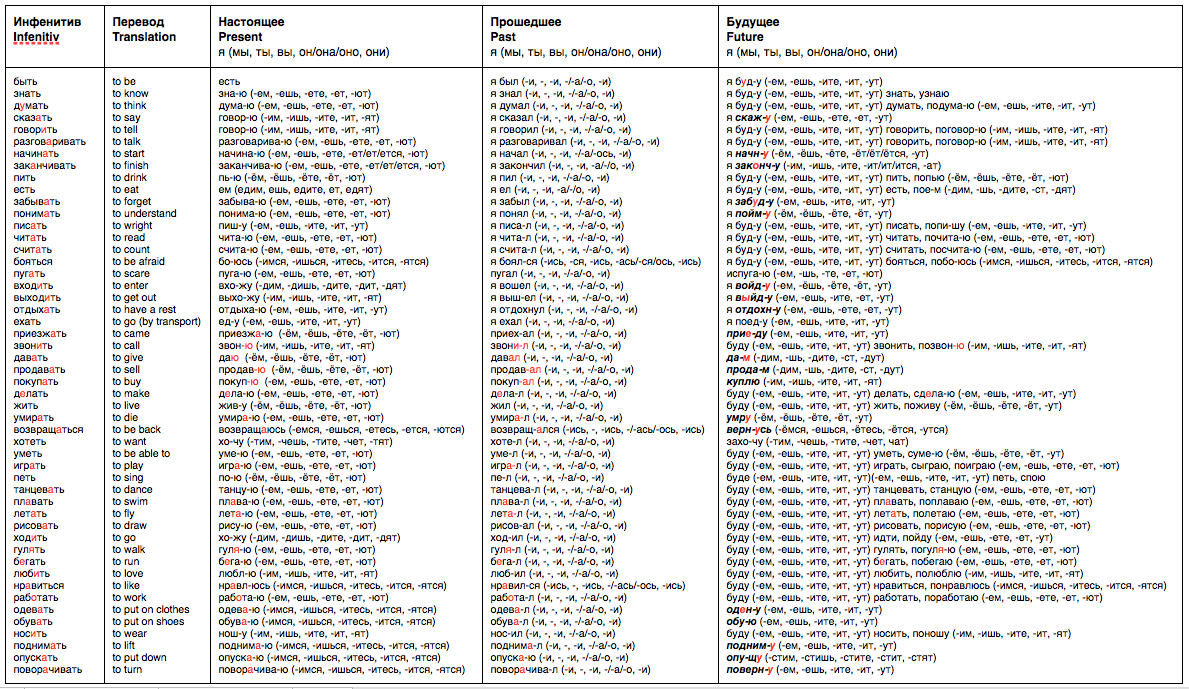
Here are some examples of common verbs that you can use as a reference. Some of them are irregular, so be wary. Click the image for a larger version to open in a new tab.
Off On Your Own
Here is the end of this site. If you now want to learn more about Russian, there are plenty of other sites and books that are more comprehensive than what I was able to create here; but I hope that what I presented here leads you to learn more Russian. Good luck! Удачи!